
E07 · Vietnamese brewing & coffee culture
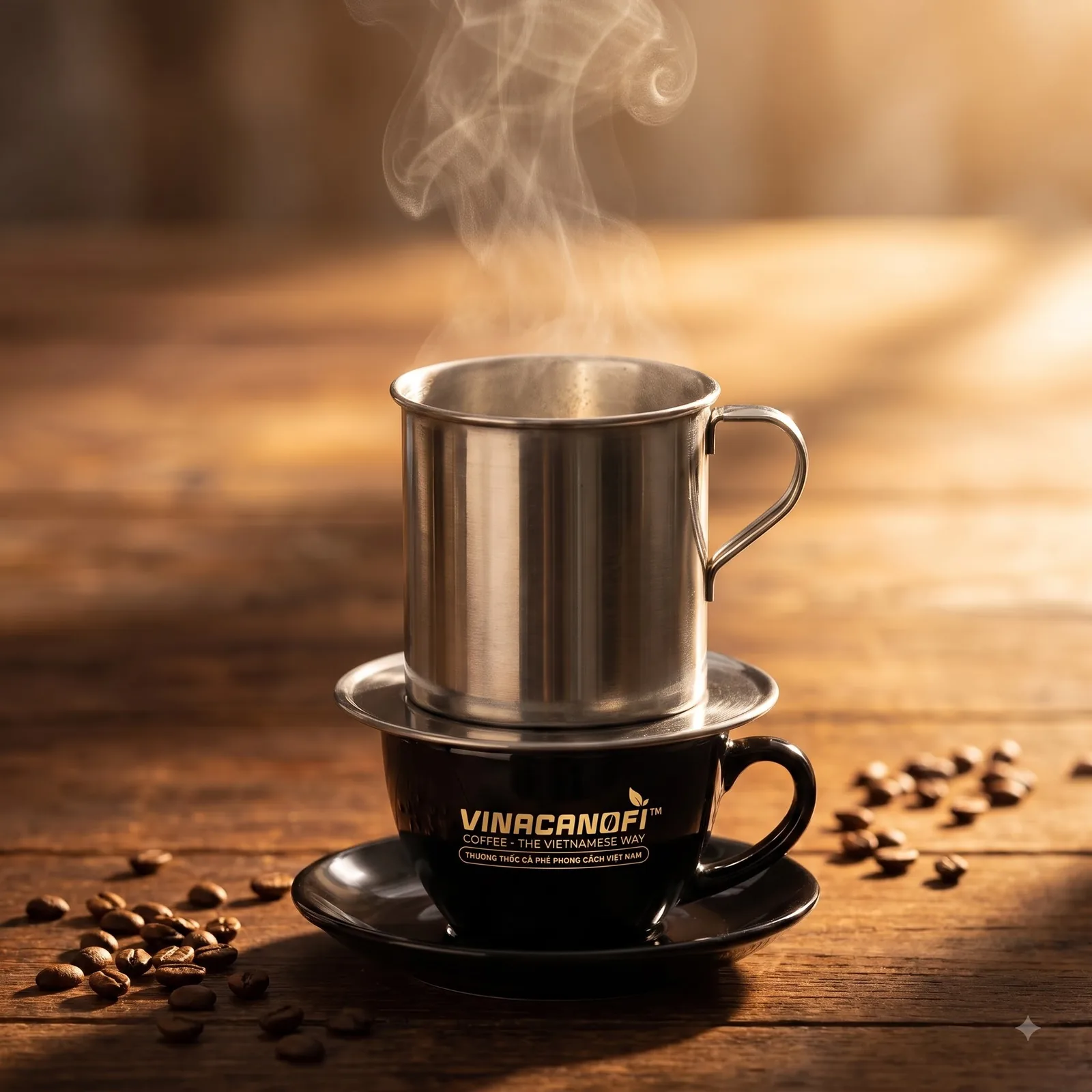
The Phin Filter — Icon of Vietnamese Coffee
Where the phin came from, what its parts are, aluminium or stainless steel, which size to choose, and tips for adjusting the drip speed for a cup you love.
- Coffee knowledge
- About VINACANOFI
- Culture & lifestyle
- Updated 21 Oct 2026

If you had to choose one object to represent Vietnamese coffee, many people would pick the phin. It is small, cheap, needs no electricity and is almost everywhere: on sidewalk café tables, in family kitchens, on office desks. The method is slow — you have to sit and wait for each drop to fall.
That slowness is exactly what made the phin part of the culture. This article doesn't repeat the step-by-step recipe for iced milk coffee (that's in Vietnamese Iced Milk Coffee). Instead, it focuses on the phin itself: where it came from, how it is built and how to use it well.
Where did the phin come from?
The word "phin" is usually explained as a Vietnamese rendering of the French filtre, meaning "filter". Coffee arrived in Vietnam with the French in the 19th century, together with European-style drip pots. Over time, Vietnamese people simplified the tool into a small metal filter that sits directly on the rim of a cup and brews for one person.
No record says exactly who made the first phin. What is clear is that it suited its circumstances: cheap, durable, easy to make, no paper filters needed, and a natural match for dark-roasted Robusta — the most widely grown coffee in Vietnam.
How a phin is built
A basic phin has four parts:
- The chamber (body): a cylinder with many small holes in the bottom. It holds the ground coffee and the water.
- The base plate: a wide rim, attached to the body or separate, that lets the phin sit steadily on a cup or glass.
- The press insert: a round perforated metal disc placed on the coffee bed to keep the grounds from floating up and to regulate the flow.
- The lid: keeps the heat in while the coffee drips. When you're done, turn it upside down and use it as a stand for the phin so it doesn't drip on the table.
Common types of phin
| Feature | Option | Characteristics |
|---|---|---|
| Material | Aluminium | Light, cheap, common in everyday cafés; dents and dulls easily |
| Stainless steel | Durable, easy to clean, steadier temperature | |
| Ceramic, copper | Less common, often decorative or given as gifts | |
| Press insert | Screw-down (threaded) | Tighten or loosen to adjust the pressure and drip speed |
| Drop-in (gravity) | Simply rests on the coffee; easy to use, the most common today | |
| Size | Single-cup | One cup, about 20–25 g of coffee |
| Large | For 2–4 people or for cafés brewing concentrate |
Screw-down phins were once a fixture in long-established cafés. The brewer could tighten the press when coffee ran fast and loosen it when it ran slow. Drop-in phins are easier to use, so they are now common in homes and offices.
Reading the drip speed
A single-cup phin usually drips through in about 4–5 minutes. That is the simplest "clock" for predicting the cup:
- Under 3 minutes, drops turning into a stream: the coffee tends to be weak, sour and thin.
- About 4–5 minutes, steady, distinct drops: usually a strong, balanced cup.
- Over 7 minutes, or almost blocked: the coffee tends to be harsh, astringent and cold before you drink it.

Four tips for adjusting the drip speed
When the phin doesn't behave, adjust one thing at a time:
- Grind size. The strongest lever. If it runs fast, grind finer; if it runs slow, grind coarser. Phin coffee should be finer than pour-over but not as fine as espresso.
- Dose. More coffee makes a thicker bed and a slower drip. Keep a fixed dose, say 20 g, before changing anything else.
- Pressing. With a drop-in phin, just place the press insert and press lightly to level the bed; pressing hard can clog it. With a screw-down phin, half a turn tighter or looser makes a clear difference.
- Pouring. Pour a little water first and let the coffee bloom for 20–30 seconds before filling up. This wets the bed evenly so the water doesn't rush through "channels". A gentle shake to level the grounds before adding the press insert also helps.
One more tip from long-time brewers: rinse the phin with boiling water before adding coffee. A warm phin keeps the water temperature steady through the minutes of dripping.
Keeping your phin clean
After each brew, empty the grounds while still warm, rinse the phin and leave it upside down to dry. Now and then, soak it in warm water with a little vinegar or baking soda to remove coffee oils from the tiny holes. Clear holes mean a steady drip.
More than a brewing tool
The phin teaches coffee drinkers to wait. In those few minutes, people chat, read the news, watch the street. That is also why the phin is so closely tied to the sidewalk café — the subject of Sidewalk Coffee Culture. To compare the phin with the more modern methods Vietnamese drinkers use today, read on with Espresso Machines in Vietnam and Vietnamese-Style Pour-Over.
Frequently asked questions
Should I choose an aluminium or a stainless-steel phin?
Aluminium phins are light and cheap, hold heat a little less well and can dent or dull over time. Stainless-steel phins are heavier, durable, easy to clean and keep a steadier temperature. Both brew well; stainless steel suits long-term home use.
Does a new phin need any preparation?
Wash it with warm water and mild soap, then rinse it with boiling water once or twice to remove any metallic smell before the first brew.
Why is my phin clogged and not dripping?
Usually the coffee is ground too fine, the dose is too large or it is pressed too hard. Next time grind a little coarser, use less coffee or just rest the press insert lightly on the surface.