
E01 · Origin & processing
How Is Coffee Grown?
From seed to ripe red cherry — what a coffee plant needs to thrive, and why Vietnam's Central Highlands became a major coffee region.
- Coffee knowledge
- About VINACANOFI
- Updated 21 Oct 2026
Every cup of coffee starts with a small shrub in the tropics. Long before it becomes a fragrant roasted bean, the coffee plant goes through years of growth, several flowering seasons and a long wait for its fruit to ripen.
What kind of plant is coffee?
Coffee is a shrub of the genus Coffea. More than a hundred species are known, but most of the coffee people drink comes from two of them:
| Arabica (Coffea arabica) | Robusta (Coffea canephora) | |
|---|---|---|
| Preferred altitude | About 1,000–2,000 m | Lower, usually below 1,000 m |
| Preferred temperature | Cool, about 15–24 °C | Warmer, about 22–30 °C |
| Hardiness | Sensitive to pests and weather | Hardy, more disease-resistant |
| Typical flavour | Bright acidity, floral, fruity | Bold, more bitter, heavy finish |
| Caffeine | Lower | Often close to twice Arabica |
Liberica and Excelsa are also grown, in much smaller quantities. Our article Coffee varieties around the world looks at them in more detail.
The life cycle of a coffee plant
Nursery. Seeds are sown in a nursery. After a few months, the seedlings are strong enough to be planted out.
Growth. A coffee plant usually needs about 3–4 years after planting before its first significant harvest. Farmers prune and shape the plant so it stays low, easy to tend and easy to pick.
Flowering. After the dry season, the first rains (or irrigation) wake the plant. Coffee flowers are white, grow in clusters along the branches, smell like jasmine and last only a few days.
Fruit and ripening. The flowers give way to green cherries that grow, turn yellow and then red when ripe. It takes a long time: roughly 6–9 months for Arabica and up to 9–11 months for Robusta.
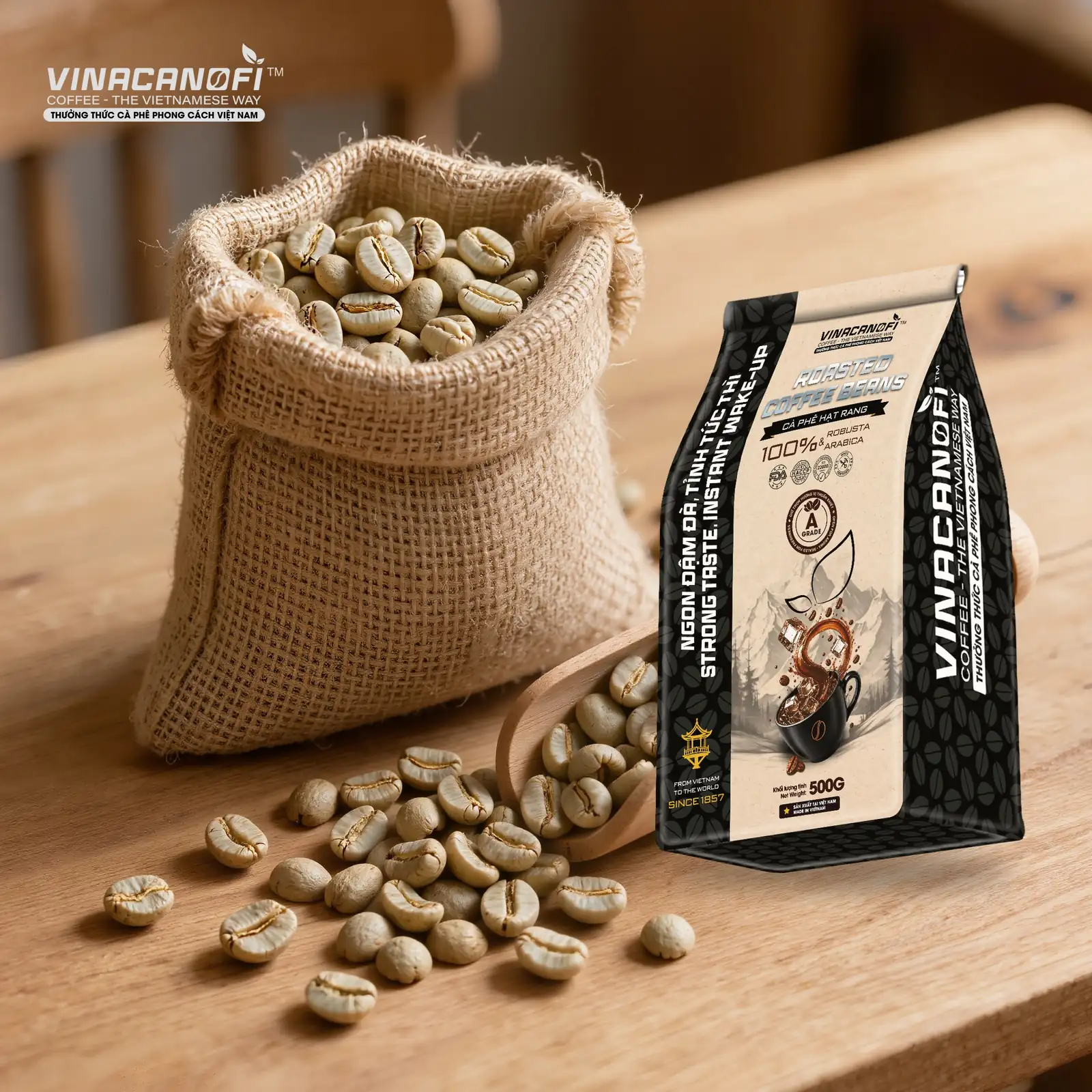
Harvest. Each ripe cherry usually holds two seeds facing each other. These are the "coffee beans" we roast and brew. Sometimes a cherry holds a single round seed, called a peaberry.
What does a coffee plant need?
- A stable climate. No frost, a clear dry season to trigger flowering and a rainy season to feed the fruit.
- Loose, well-drained soil. Coffee roots cannot stand waterlogging. Soil rich in organic matter keeps plants healthy and cherries even.
- Moderate light. Many farms plant shade trees to soften strong sun and keep the soil moist.
- Hands-on care. Pruning, fertilising, dry-season watering and picking all need human hands. That is why coffee is tied so closely to the livelihoods of millions of smallholder farmers.
Why the Central Highlands grow so much coffee
According to commonly cited industry history, coffee was brought to Vietnam in 1857. Today Vietnam is one of the world's largest coffee producers and is especially strong in Robusta.
The main growing area is the Central Highlands: Đắk Lắk, Gia Lai, Lâm Đồng, Đắk Nông and Kon Tum. The region has what coffee needs:
- Red basalt soil from ancient volcanoes, loose and good at holding moisture.
- Altitudes of roughly 500–1,000 m in many areas, cool enough for healthy growth.
- Two distinct seasons: the dry season helps the plants flower more evenly, and the rainy season feeds the fruit. The Robusta harvest in the Central Highlands usually runs from about October to January.
In Vietnam, Arabica is grown in higher, cooler places such as Lâm Đồng (Cầu Đất), Sơn La and Quảng Trị.
From branch to cup
After picking, coffee cherries still have to be processed to separate the beans, dried, sorted, and only then roasted and brewed. Every step shapes the final flavour. The next articles in this series cover care and harvest, then post-harvest processing methods.
Frequently asked questions
How long does a coffee plant live?
A well-tended coffee plant can bear fruit for 20–30 years. Many farms replant or graft new varieties when yields decline.
Why don't coffee cherries ripen at the same time?
The plant flowers in several waves after rain, so one branch can carry green, yellow and red cherries at once. That is why selective picking of ripe cherries gives better quality than stripping a whole branch.
Is Arabica better than Robusta?
Neither is better in absolute terms. Arabica tends to be brighter and fruitier; Robusta is bolder, more bitter and higher in caffeine. It is a matter of taste.