
E03 · Origin & processing
Post-Harvest Processing
From fresh cherry to green bean — the three main processing methods (natural, washed, honey), drying, hulling, sorting, then roasting and instant coffee.
- Coffee knowledge
- About VINACANOFI
- Updated 21 Oct 2026
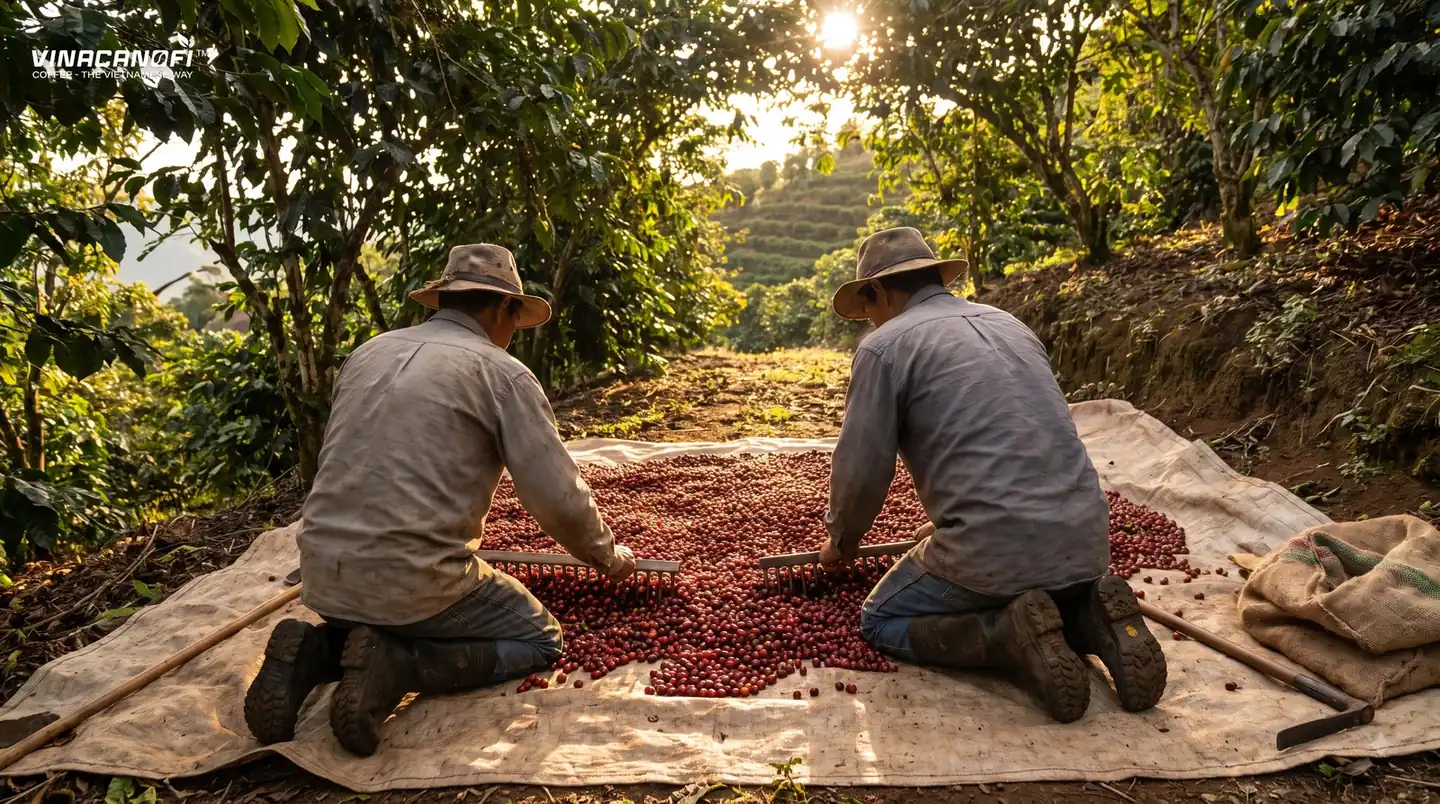
A freshly picked coffee cherry is still a long way from the coffee we brew each morning. Under the red skin are the fruit flesh, a sweet sticky layer, a thin parchment shell, and only then the bean. How these layers are removed, and how the bean is dried, is called post-harvest processing. It is one of the steps with the biggest influence on flavour.
Inside a coffee cherry
From the outside in, a coffee cherry has:
- Skin — thin, red or yellow when ripe.
- Pulp — a thin layer of sweet flesh.
- Mucilage — a sticky, sugary layer around the bean.
- Parchment — a hard, paper-thin shell.
- Silver skin — a very thin membrane on the bean.
- Bean — usually two beans facing each other. This is the part we roast and brew.
The aim of processing is to get the bean out and bring it to a safe moisture level without letting it over-ferment or go mouldy.
The three main processing methods
Natural (dry) process
The whole cherries are dried on patios, tarpaulins or raised beds for about 2–4 weeks, turned every day until dry. Only then is the dried outer layer hulled off.
- Typical flavour: sweet, bold, ripe fruit, heavy body.
- Challenge: easily over-ferments or moulds if the weather is humid or turning is uneven.
This is the oldest method and uses little water. It is common in Brazil and Ethiopia — and in Vietnam for most Robusta.
Washed (wet) process
The skin and pulp are removed right after picking. The remaining mucilage is broken down by fermenting the beans in water tanks for about 12–48 hours, then washed off. The beans, still in parchment, are dried.
- Typical flavour: clean, clear, bright acidity, origin character easy to pick out.
- Challenge: needs plenty of water and equipment, and wastewater must be treated.
This method is common for Arabica in Colombia, Kenya and Central America.
Honey (semi-washed) process
The skin and pulp are removed, but some or all of the mucilage is left on during drying. The mucilage dries into a yellow, red or dark coating around the bean. Depending on how much is left and how it is dried, it is called yellow, red or black honey.
- Typical flavour: between the other two — sweeter than washed, cleaner than natural.
- Challenge: needs frequent turning because the mucilage is sticky; moulds easily if drying is slow.
| Natural | Washed | Honey | |
|---|---|---|---|
| What is dried | Whole cherry | Bean washed free of mucilage | Bean with mucilage on |
| Water use | Very low | High | Low |
| Typical flavour | Ripe fruit, heavy body | Clean, bright | Sweet, balanced |
Drying, hulling, sorting
Drying. Whatever the method, the beans must be dried to about 10–12% moisture. Too dry and the beans turn brittle and lose aroma; too moist and they can mould in storage. Besides sun drying, many processors use mechanical dryers so they are not at the mercy of the rain.
Hulling. The dried beans go through a huller to remove the dried husk (natural process) or the parchment (washed and honey). The result is green coffee — hard, grey-green beans that do not yet smell like coffee.
Sorting. Green coffee is screened by size, separated by density, and in some places colour-sorted by machine or hand-picked to remove black, broken and insect-damaged beans, stones and debris. The more uniform the beans and the fewer the defects, the higher the price. The coffee is then bagged and stored somewhere dry and well ventilated.
Roasting: when green beans start to smell like coffee
Roasting turns green beans into fragrant brown beans. In the drum, the beans heat up to roughly 190–230 °C. Sugars and amino acids react with each other, creating hundreds of aroma compounds; the beans lose water, swell and make a crackling sound known as the "crack".
| Roast level | Bean colour | Typical flavour |
|---|---|---|
| Light | Light brown, dry surface | Bright acidity, floral, fruity |
| Medium | Medium brown | Balanced, sweet, caramel, nutty |
| Dark | Dark brown, may look oily | Bold, bitter, chocolate, smoky |
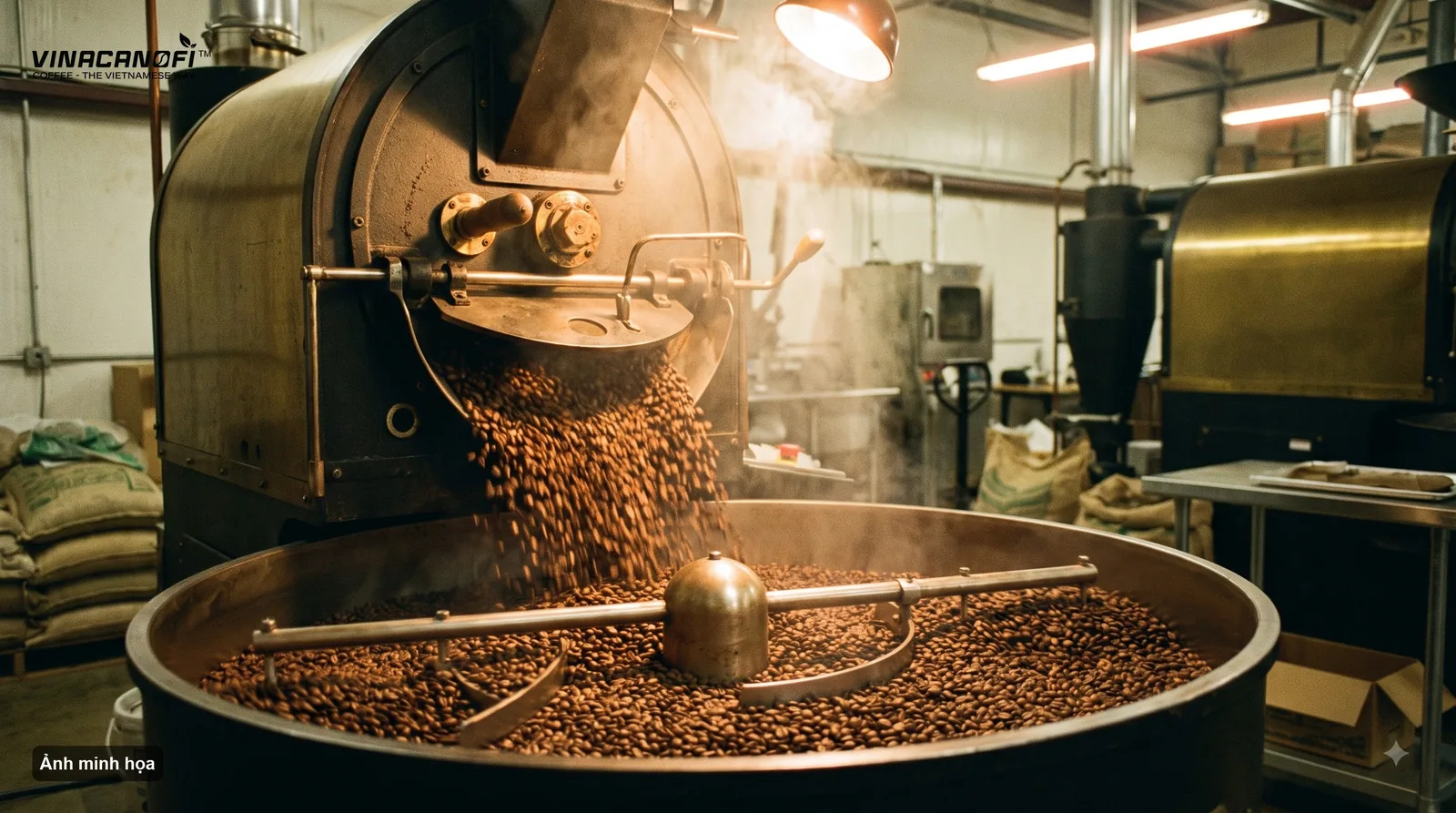
Traditional Vietnamese phin coffee usually uses a medium to dark roast, which suits the boldness of Robusta and pairs well with condensed milk.
From roasted beans to instant coffee
Instant coffee also starts from roasted beans. The beans are ground and extracted into a concentrated coffee liquid, then dried in one of two ways:
- Spray drying: the coffee liquid is sprayed as a mist into hot air; the water evaporates quickly, leaving a fine powder.
- Freeze drying: the coffee liquid is frozen, then the water is removed by sublimation under vacuum at low temperature, leaving crisp granules. It costs more but keeps aroma better.
To make a cup, you simply add water to dissolve the extracted coffee again.
One bean, many choices
Between picking and bagging, every coffee lot goes through many choices: how to process it, how long to dry it, which beans to remove. These choices explain why two bags of coffee from the same region can still taste very different. The next article, Coffee Varieties Around the World, looks at the remaining factor: coffee species, varieties and growing regions.
Frequently asked questions
Does "honey" coffee contain honey?
No. "Honey" refers to the sweet, sticky mucilage around the bean after the skin is removed. Leaving it on during drying gives the coffee more sweetness and body. No honey is added.
How long do green coffee beans keep?
If dried to the right moisture and stored somewhere cool and dry, green beans keep their quality for many months, usually around a year. Roasted coffee loses its aroma much faster.
Does dark roast have more caffeine than light roast?
Not meaningfully. The difference is mainly flavour — dark roasts taste bolder and more bitter, light roasts keep more bright acidity and fruit. Caffeine content barely changes with roast level.